I often look back at my childhood with a smile. My brothers and I would memorise theme songs from our favourite TV shows and sing them loudly, sometimes off-key, throughout the entire programme. My mother would shake her head and say, “If only you could memorise your schoolwork the same way, you’d be getting distinctions!” At the time, I never understood why those songs stuck so easily, yet schoolwork felt like an impossible mountain to climb.
As I grew older, I realised something simple but powerful: learning was not fun for us. Personally, I struggled with subjects like Chemistry and Physics, not because I lacked interest, but because I never fully grasped the foundational concepts. To this day, I still wonder whether the teaching approach failed me, or whether I was simply not prepared to learn in the way it was taught.
Fast forward to my years as a lecturer, and this reflection began to make even more sense. One of the pillars of quality education is knowledge retention, the ability to remember, apply, and transfer knowledge long after the exam. Yet many students have mastered the “system”: cram today, pass tomorrow, forget the next day. By graduation, a worrying number barely recall what they studied.
And as lecturers, we feel the fatigue too. Marking identical assignments, sometimes clearly generated by AI, can be mentally draining. You read the same ideas from different students, give the same feedback, and repeat the cycle every semester. It becomes clear that the traditional learning and assessment model is no longer serving either side well.
The 30-Second Assignment Experiment
This year, I decided to try something different, something unexpected: a 30-second assignment. I still remember the mixture of confusion and excitement when I announced it to my class: “We’re doing a 30-second assignment this semester!”
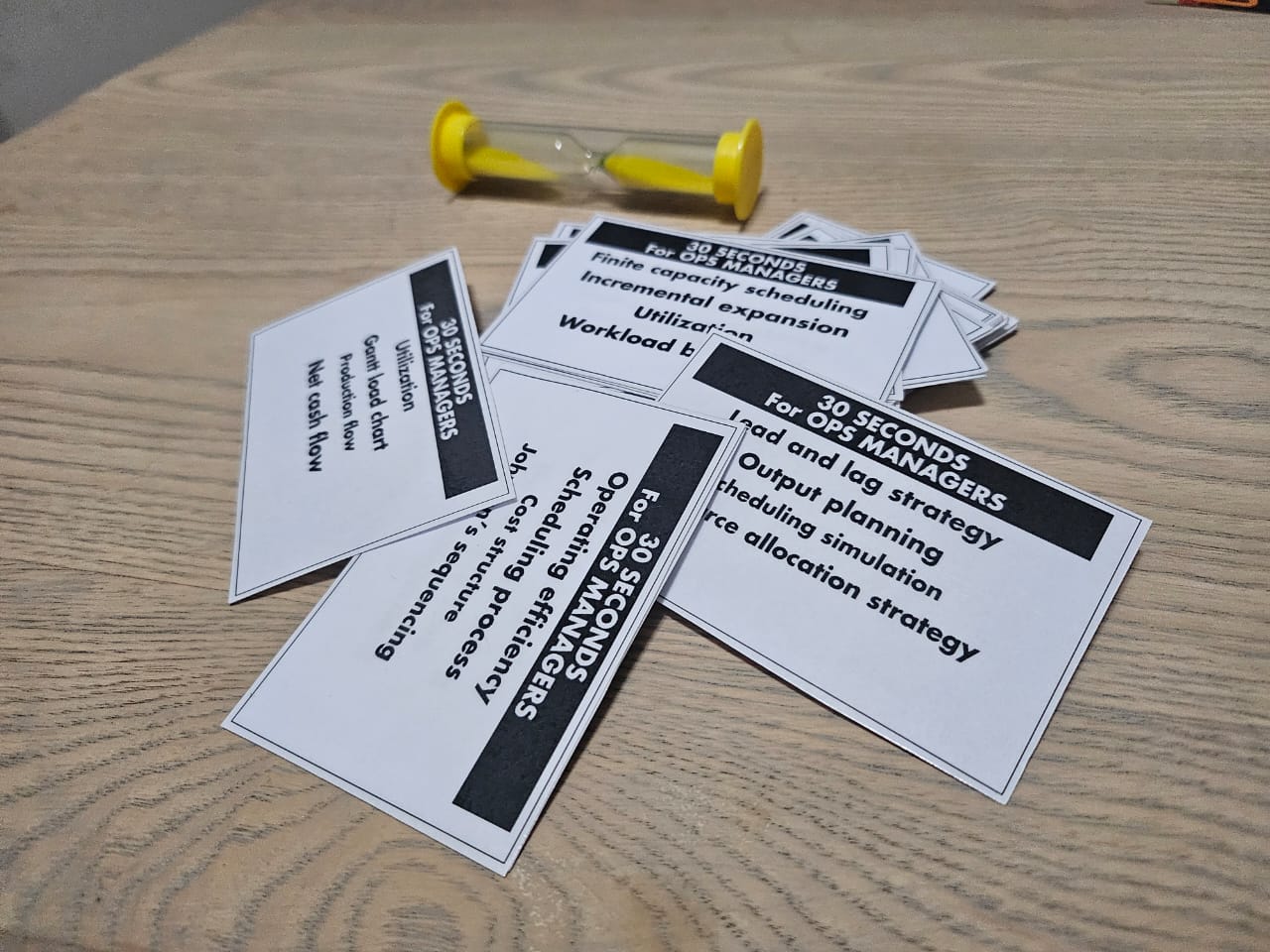
The idea was simple: Students were given cards containing key terms from two chapters, Capacity Planning and Short-Term Scheduling, which they had to unpack in just 30 seconds. They worked in groups, but here was the twist: the chapters were not taught in class. They had to self-study, prepare, and collaborate creatively.
To my delight, the level of engagement skyrocketed. Their energy was contagious. They didn’t just define the terms, they applied them, contextualised them, debated them, and even joked about them. The assignment became a mini-game, and learning became something they did, not something they endured.
What fascinated me most was what happened afterwards. Weeks later, right up to the end of the semester, students could still recall specific concepts. Some remembered them because the clues in the game were funny; others remembered them because the activities helped the concepts stick. This made me wonder:
Is there a measurable link between fun, gamified learning experiences and long-term knowledge retention?
It’s just an assumption for now, but it’s one I am seriously considering exploring as a research project.
Why Gamification Matters, Especially for Gen Z
With Gen Z comprising the majority of today’s learning environment, traditional teaching methods cannot remain unchanged. This generation thrives on interactivity, instant feedback, creativity, and engaging content. Gamification, whether through time-based tasks, challenges, rewards, or interactive group activities, could be one of the keys to transforming the learning experience.
Next year, I plan to replicate the assignment, refine the approach, and observe the outcomes even more closely. I’m excited to see the results and, of course, share the journey with you.